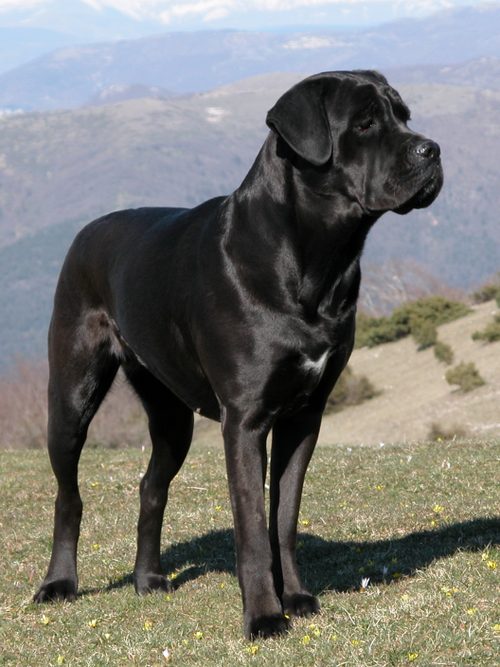
| Size at withers | 60–70 cm |
|---|---|
| Weight range | 40–50 kg |
| Life expectancy | 9–12 years |
| Size class | Giant (> 40 kg) |
| Normal resting vitals | Heart rate 60–100 bpm · Respiration 10–30/min · Temperature 38.3–39.2 °C |
| Coat | Short, stiff coat |
| Temperament | Powerful, loyal, territorial; requires experienced handling |
| Common health issues | Hip and elbow dysplasia; gastric torsion; entropion / ectropion; demodectic mange; idiopathic epilepsy |
| Exercise needs | High — 60 min/day |
| Climate & housing suitability | Moderate; heat tolerance is limited. |
| Owner notes | Not for first-time owners. Increasingly popular but widely mis-owned. |
Origin and purpose
Working (AKC). Origin: Italy.
Not for first-time owners. Increasingly popular but widely mis-owned.
What a breed was built to do explains most of what it will do in your home. A dog selected for hundreds of years to run, guard, herd, or hunt does not stop wanting to because it now lives in an apartment — the drive is the breed, and the owner's job is to give it somewhere to go.
Temperament and training
Stated temperament: Powerful, loyal, territorial; requires experienced handling
A guarding breed: it is naturally suspicious of strangers, and that is what it was bred for. Early, broad, positive socialisation — many people, many places, many situations, before sixteen weeks — is not optional for this breed; it is the difference between a discriminating guardian and a dangerous liability. A guarding dog that has not been socialised is a problem you have created, not a temperament you have discovered.
Conditions this breed is predisposed to
Gastric dilatation and volvulus (GDV, 'bloat')
Idiopathic epilepsy
Demodectic mange (demodicosis)
Ectropion
Elbow dysplasia
Entropion
Health screening — what to test, and when
| Screen for | Test | When |
|---|---|---|
| Demodectic mange (demodicosis) | Skin scrape | On patchy hair loss in a young dog |
| Ectropion | Eye examination | Annually |
| Elbow dysplasia | Radiographic elbow evaluation | Once at 12–24 months |
| Entropion | Eye examination | Annually |
| Gastric dilatation and volvulus (GDV, 'bloat') | No screening test. Discuss preventive gastropexy with your vet in deep-chested breeds | At neutering, if the vet agrees it is indicated |
| Idiopathic epilepsy | No screening test. Diagnosis is by exclusion, after blood work and imaging | Investigate the first seizure; do not breed from affected dogs |
Every dog, every breed: an annual health examination (twice yearly from seven years), body-condition scoring at each visit, dental assessment, year-round parasite control, and the core vaccinations.
For breeders — test before you mate
- Demodectic mange (demodicosis) — Skin scrape
- Ectropion — Eye examination
- Elbow dysplasia — Radiographic elbow evaluation
- Entropion — Eye examination
- Gastric dilatation and volvulus (GDV, 'bloat') — No screening test. Discuss preventive gastropexy with your vet in deep-chested breeds
- Idiopathic epilepsy — No screening test. Diagnosis is by exclusion, after blood work and imaging
Feeding
Slow, controlled growth is essential — giant-breed puppies grow for eighteen months or more, and pushing that growth with over-feeding or calcium supplementation causes lasting orthopaedic damage. Use a diet formulated for large- or giant-breed growth and keep the puppy visibly lean. As an adult, two measured meals a day, never one large one. Feeding costs are substantial and should be budgeted before acquiring the dog.
Exercise and enrichment
Stated requirement: High — 60 min/day
A high-energy dog needing substantial, committed daily exercise plus mental work. Do not take this breed on unless the daily commitment is realistic on your worst week, not your best one.
Coat and grooming
Short, stiff coat. Weekly rub-down.
Climate and living conditions
Stated suitability: Moderate; heat tolerance is limited.
Ageing and senior care
Life expectancy: 9–12 years. This dog is a senior from around 5–6 years, at which point wellness examinations should move to twice a year and senior blood and urine screening begins. Giant breeds age fast and live short lives, and this is the hardest fact about owning one. Senior screening should start early, orthopaedic support matters from middle age, and cardiac and bone cancer risks are real. Go in with your eyes open. Senior care →
Before you take one home
- Ask the breeder for the health-test results listed above — for BOTH parents, on paper, before you pay a deposit. A breeder who has done the tests will be proud to show you; one who deflects, or who tells you the tests are unnecessary in this line, is telling you what you need to know.
- This is a short-skulled breed. Choose the puppy with the most open nostrils and the longest muzzle you can find, and reject any that snores, snorts, or struggles for breath at rest — those are not endearing breed traits, they are signs of a dog that cannot breathe properly. Ask whether the parents have been BOAS-graded. In a hot climate this decision has consequences you will live with daily.
- Consider adoption. Shelters and rescues have dogs of every kind, including purebreds, and the local native or landrace dog is often healthier, better adapted to its climate, and more in need of a home than almost anything you can buy. See Part XII.