Bulldog (English)
| Size at withers | 31–40 cm |
|---|---|
| Weight range | 18–25 kg |
| Life expectancy | 8–10 years |
| Size class | Small–Medium (10–25 kg) |
| Normal resting vitals | Heart rate 70–120 bpm · Respiration 15–30/min · Temperature 38.3–39.2 °C |
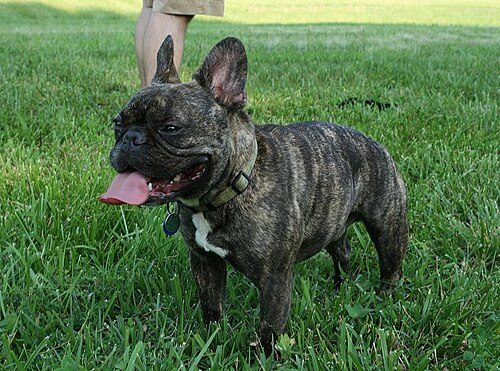
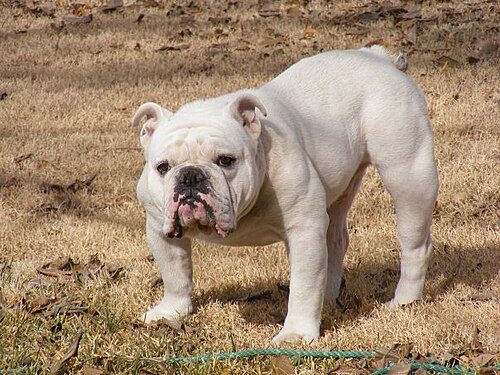
| Coat | Very short, smooth coat with deep facial folds |
| Temperament | Docile, courageous, patient; low activity |
| Common health issues | Brachycephalic airway syndrome (severe); skin fold dermatitis; hip and elbow dysplasia; C-section-required births; heatstroke |
| Exercise needs | Low — 20–30 min/day |
| Climate & housing suitability | Poor for hot summer climates. |
| Owner notes | Considered by some veterinary societies a breed whose typical conformation is not compatible with good welfare. An informed acquisition decision is required. |
Origin and purpose
Non-sporting (AKC). Origin: England.
Considered by some veterinary societies a breed whose typical conformation is not compatible with good welfare. An informed acquisition decision is required.
What a breed was built to do explains most of what it will do in your home. A dog selected for hundreds of years to run, guard, herd, or hunt does not stop wanting to because it now lives in an apartment — the drive is the breed, and the owner's job is to give it somewhere to go.
Temperament and training
Stated temperament: Docile, courageous, patient; low activity
Reward-based training from the day the puppy arrives, with the socialisation window (roughly three to sixteen weeks) treated as the priority it is — what happens in those weeks shapes the adult dog more than anything you do later. Short, frequent, positive sessions. See Parts IV and IX.
Conditions this breed is predisposed to
Heatstroke (hyperthermia)
Brachycephalic obstructive airway syndrome (BOAS)
Elbow dysplasia
Skin fold dermatitis
Health screening — what to test, and when
| Screen for | Test | When |
|---|---|---|
| Brachycephalic obstructive airway syndrome (BOAS) | BOAS functional grading (an exercise-tolerance assessment) | Before breeding, and before any anaesthetic — and before buying the puppy |
| Elbow dysplasia | Radiographic elbow evaluation | Once at 12–24 months |
Every dog, every breed: an annual health examination (twice yearly from seven years), body-condition scoring at each visit, dental assessment, year-round parasite control, and the core vaccinations.
For breeders — test before you mate
- Brachycephalic obstructive airway syndrome (BOAS) — BOAS functional grading (an exercise-tolerance assessment)
- Elbow dysplasia — Radiographic elbow evaluation
Feeding
The most forgiving size to feed. A good-quality complete diet appropriate to the life stage, measured with a cup or scales rather than judged by eye, split into two meals a day. Weigh the food; guessing is how dogs get fat. Treats counted within the daily allowance, not added on top.
Exercise and enrichment
Stated requirement: Low — 20–30 min/day
Modest exercise needs, but 'low exercise' is not 'no exercise' — this dog still needs daily walks and enrichment, and is prone to obesity if it does not get them.
Coat and grooming
Very short, smooth coat with deep facial folds. Weekly brush; clean and DRY every fold several times a week. Brachycephalic — this breed is severely heat-intolerant.
Climate and living conditions
Stated suitability: Poor for hot summer climates.
Ageing and senior care
Life expectancy: 8–10 years. This dog is a senior from around 8–9 years, at which point wellness examinations should move to twice a year and senior blood and urine screening begins. Watch for the gradual onset of arthritis, dental disease, and the endocrine conditions of middle age. Senior care →
Before you take one home
- Ask the breeder for the health-test results listed above — for BOTH parents, on paper, before you pay a deposit. A breeder who has done the tests will be proud to show you; one who deflects, or who tells you the tests are unnecessary in this line, is telling you what you need to know.
- This is a short-skulled breed. Choose the puppy with the most open nostrils and the longest muzzle you can find, and reject any that snores, snorts, or struggles for breath at rest — those are not endearing breed traits, they are signs of a dog that cannot breathe properly. Ask whether the parents have been BOAS-graded. In a hot climate this decision has consequences you will live with daily.
- Consider adoption. Shelters and rescues have dogs of every kind, including purebreds, and the local native or landrace dog is often healthier, better adapted to its climate, and more in need of a home than almost anything you can buy. See Part XII.